

Revolution Day 2026: More Important Than Ever Because the Revolution Isn't Over
Writer: Andrew Macfarlane
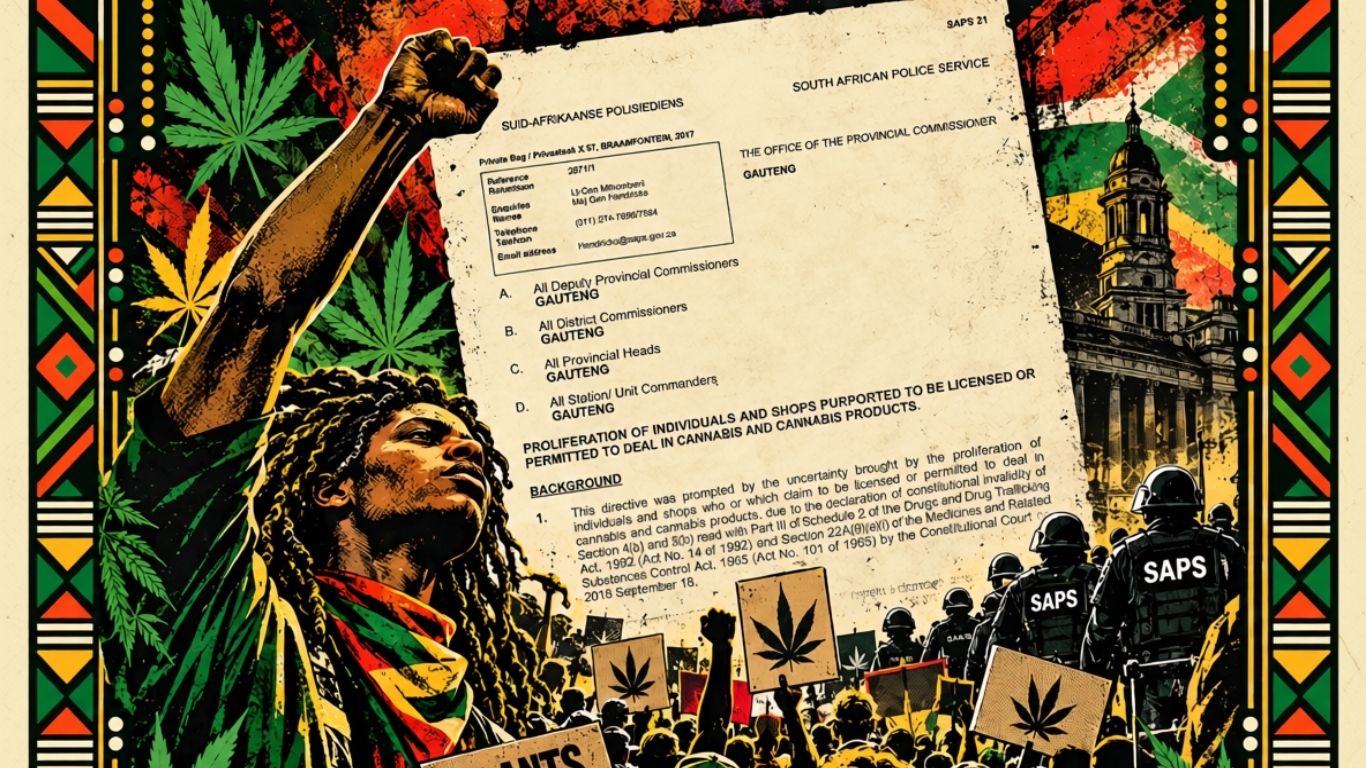
Just days before Revolution Day 2026, a five-page document reportedly leaked from the Gauteng police has raised fresh concerns about the future of South Africa’s cannabis industry.
Although the document is attributed to the Gauteng Provincial Commissioner’s office, its authenticity has not been independently confirmed, and SAPS has yet to publicly verify it.
If genuine, the document suggests that police operations could go well beyond routine paperwork checks at cannabis businesses.
It outlines procedures for obtaining search-and-seizure warrants, conducting joint operations with SAHPRA and environmental health inspectors, and pursuing criminal charges where unlawful dealing is identified.
It also covers undercover operations, arrests, cannabis cultivation arrangements and investigations into suppliers. It’s worth reading the document in full.
Appearing just days before the second annual Revolution Day, the reported directive is a timely reminder that, despite years of activism and important legal victories, South Africa still has some way to go in resolving questions around cannabis access and regulation.
We’re not simply remembering the revolution. We’re still living through it.

What Can South Africans Legally Do With Cannabis?
Let’s start with what the Constitutional Court actually decided in September 2018.
In its landmark Minister of Justice and Constitutional Development v Prince judgment, the Court ruled that criminalising adult private cannabis use, possession and cultivation for personal consumption violated Section 14 of South Africa’s Constitution.
Section 14 protects the right to privacy.
In other words, the government couldn’t simply continue treating adults as criminals for using or growing cannabis privately for themselves.
This was a constitutional ruling, not a temporary concession from the government.
What South African Adults Are Constitutionally Protected to Do
Under the 2018 judgment, adults aged 18 and older have the following protections:
- Consume cannabis privately: Adults may use cannabis in private for their own personal consumption.
- Possess cannabis privately: Adults may possess cannabis privately for personal use.
- Grow their own cannabis: Adults may cultivate cannabis in a private place for personal consumption.
- Exercise these protections beyond their homes: Private cannabis use isn’t necessarily restricted to your home. However, whether a particular location qualifies as private depends on the circumstances.
You don’t need a medical cannabis prescription to enjoy these rights. They’re protected by the Constitution.
But that doesn’t mean anything goes once you’re on private property.
The 2018 judgment doesn’t protect public consumption or commercial dealing. The judgment also doesn’t authorise cannabis use around children or non-consenting adults.
The Cannabis for Private Purposes Act, signed in 2024 but not yet brought into force, provides for fines of up to R2,000 for cannabis use in the immediate presence of a child or non-consenting adult.
Those particular penalties aren’t in effect yet, but the principle is straightforward: respect other people’s space. Check that non-smokers are comfortable before lighting up, and never consume cannabis around children.
And that brings us to the Act itself, where things become a little more complicated.
Where Does the Cannabis for Private Purposes Act Fit In?
In May 2024, President Cyril Ramaphosa signed the Cannabis for Private Purposes Act, just one day before South Africa’s national elections.
Interesting timing, wouldn’t you say?
The Act was intended to give effect to the Constitutional Court’s 2018 judgment by creating a framework for private cannabis use, possession and cultivation.
It also includes provisions to clear certain historical cannabis-related criminal records.
But here’s where things get complicated.
Signing an Act doesn’t necessarily mean it has taken effect.
More than two years later, the Act has yet to come into force.
In February 2026, the Department of Justice published draft regulations proposing limits on how much cannabis adults could possess and how many plants they could grow.
However, publishing a proposal doesn’t automatically make it law.
The Department of Justice confirmed that the proposed limits still needed to go through the regulatory approval process.
And here’s something important to remember: the Constitutional Court never set a specific gram limit or number of plants for personal use.
Instead, the Court recognised that the amount of cannabis someone possesses could help determine whether it was intended for personal consumption or another purpose.
That assessment depends on the circumstances, not simply a number on a scale.
So, while the government continues working through the legislation and proposed regulations, the constitutional protections established in 2018 remain in place.

Why the Distinction Matters
The reported Gauteng police directive shows why understanding these different laws matters.
Police investigating businesses suspected of selling cannabis illegally aren’t necessarily challenging your constitutional right to grow, possess or use cannabis privately.
Commercial cannabis sales and private personal use are separate legal matters.
But there’s also a difference between enforcing the law and overstepping it.
Police must still respect constitutional rights, follow the correct procedures and remain accountable for their actions.
Understanding what the law protects, and recognising when those protections might be challenged, helps ensure that progress isn’t lost.
What Does the Reported Gauteng Police Directive Actually Say?
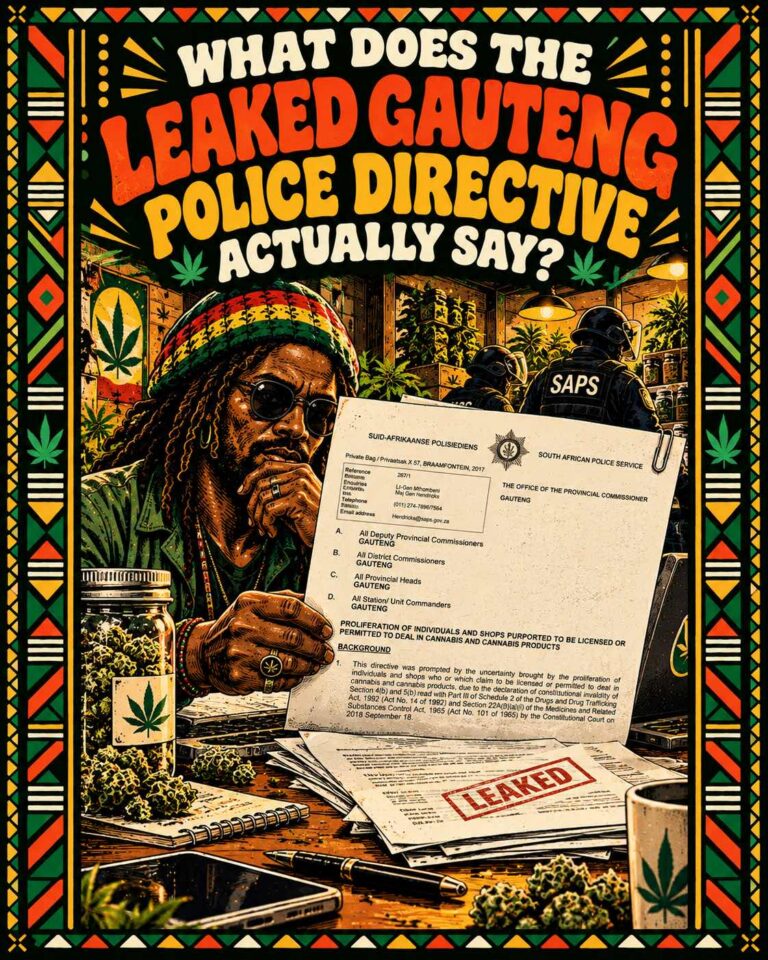
The document is titled Proliferation of Individuals and Shops Purported to Be Licensed or Permitted to Deal in Cannabis and Cannabis Products.
It’s quite a mouthful, but the procedures described are surprisingly detailed. They deserve scrutiny, whether or not SAPS confirms the document’s authenticity.
The document focuses on businesses and individuals claiming that licences or permits issued by SAHPRA authorise them to sell cannabis and cannabis products.
What follows is a breakdown of the instructions contained in the purported directive, not confirmation that SAPS has formally adopted or implemented them.
1. Obtain a Search-and-Seizure Warrant
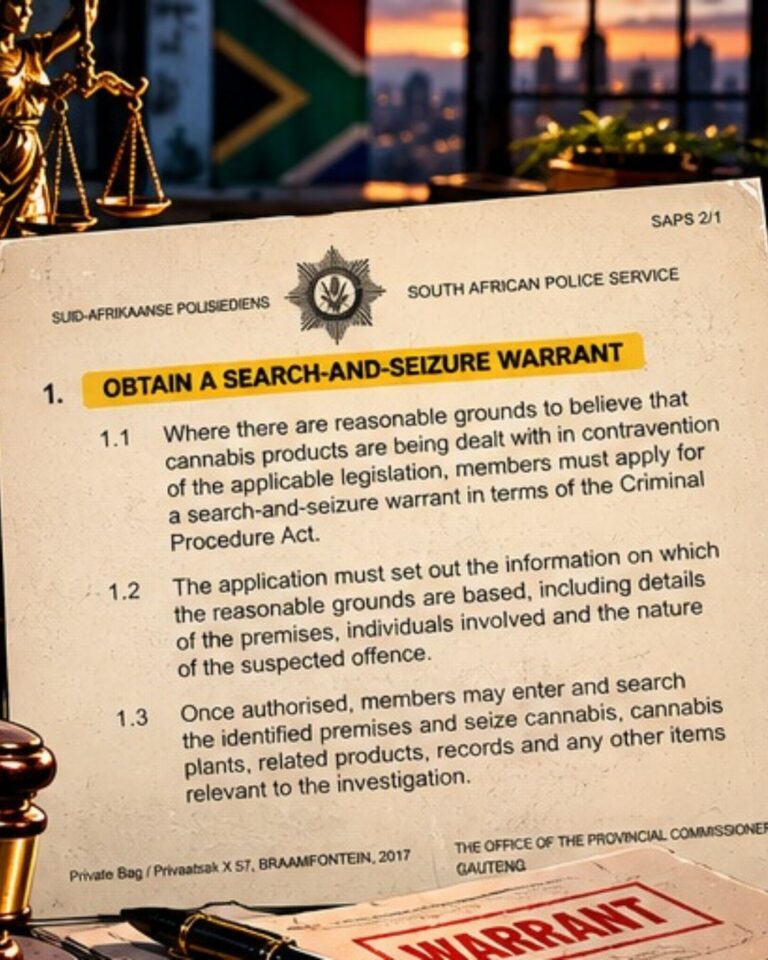
For shops known to be dealing in cannabis products, the document calls for police to apply for a search-and-seizure warrant under Section 21 of the Criminal Procedure Act.
Once the warrant has been granted, the document says officers should conduct the operation alongside SAHPRA and environmental health inspectors.
A photographer from the Local Criminal Record Centre should also attend where possible to document products displayed in the shop.
But here’s something business owners should understand.
A search warrant isn’t simply a piece of paper giving police unlimited access to everything in your business.
In the Minister for Safety and Security v Van der Merwe judgment, the Constitutional Court explained that warrants must clearly identify the suspected offence, the premises to be searched and the items officers are authorised to seize.
Warrants that are excessively broad, unclear or issued without the necessary legal grounds can be challenged.
So, if police arrive at your business, ask to see the warrant, check that it covers your premises and establish what officers are authorised to search and seize.
It’s also sensible to record the officers’ names, ranks and identification details.
However, there are circumstances in which police can legally search without a warrant. An apparent paperwork problem doesn’t automatically give anyone the right to prevent an operation.
We’re not legal experts, and we’re certainly not suggesting anyone should obstruct police.
Keep your business documents, permits, invoices and supplier records organised, and have the details of a lawyer available.
If something appears to be wrong with a search, document it and obtain legal advice.
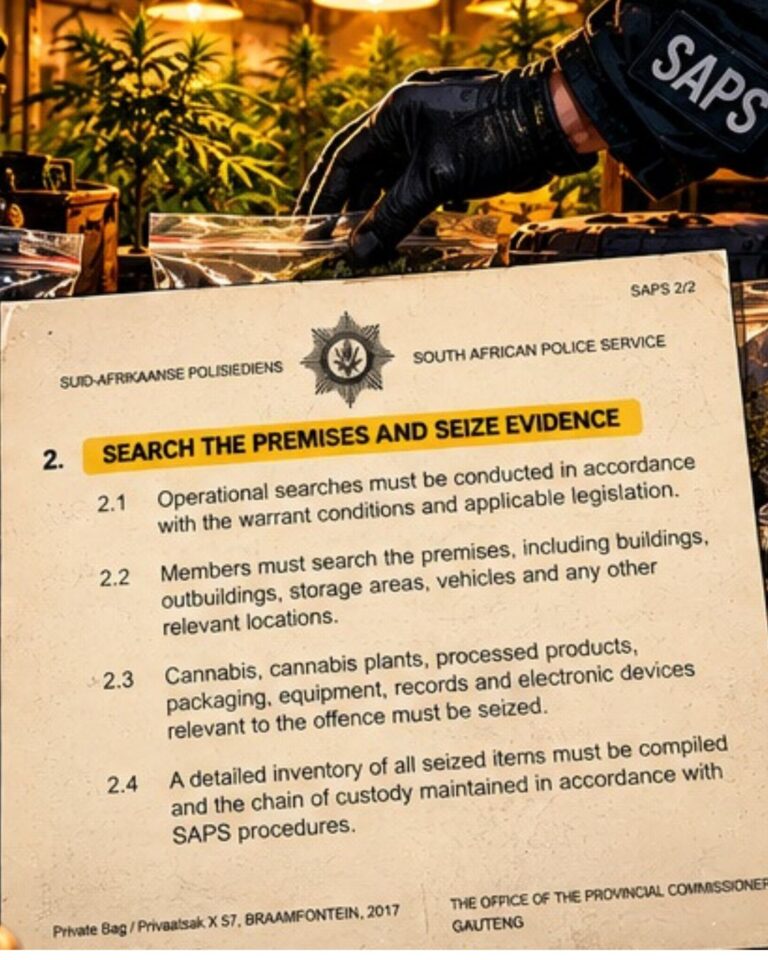
2. Search the Premises and Seize Evidence
Under the procedures described, SAPS officers would investigate cannabis found on the premises, while SAHPRA and environmental health inspectors address relevant regulatory issues surrounding cannabis products.
Where officers believe unlawful dealing has taken place, the document calls for charges under the Drugs and Drug Trafficking Act and the Medicines and Related Substances Control Act.
Cannabis-infused foods, including cookies, are also singled out for possible action under food safety legislation.
However, the document doesn’t explain whether seized products must be sent to SAHPRA for laboratory testing, who will physically retain the stock or how products will be assessed if their legal status is disputed.
Nor does the document explain what happens when the different authorities involved disagree about a product.
These are important questions.
For a cannabis business, having stock removed could mean substantial financial losses, even before a criminal case reaches court.
And that leads to another question: what happens if the stock shouldn’t have been seized in the first place?
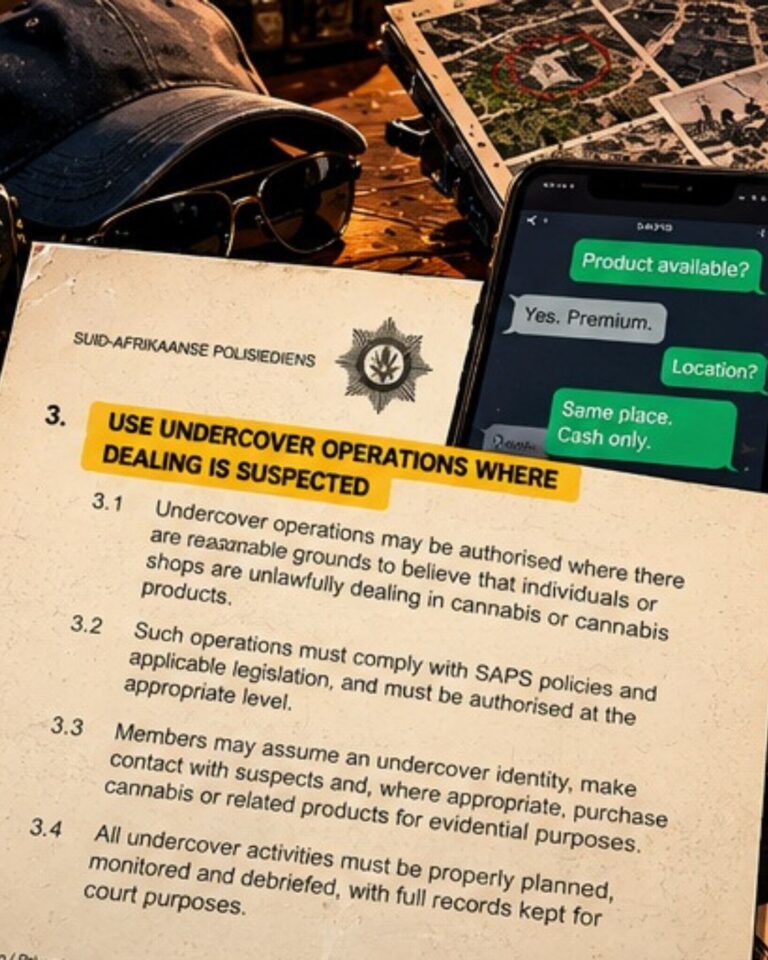
3. Use Undercover Operations Where Dealing Is Suspected
Where police suspect unlawful cannabis dealing, paragraph 14 of the purported directive calls for an undercover operation under Section 252A of the Criminal Procedure Act, together with an application for a search-and-seizure warrant.
The document then describes an operation intended to establish whether dealing is taking place.
If officers identify dealing, the document calls for evidence to be seized and the suspect arrested.
It also says cannabis requiring weighing must be weighed in the suspect’s presence.
Section 252A governs traps and undercover operations, including questions about whether police conduct goes beyond providing an opportunity to commit an offence.
Importantly, following an internal directive doesn’t automatically establish that every undercover operation or the evidence it produces will be lawful.
That remains subject to the Criminal Procedure Act and scrutiny by the courts.

4. Investigate Cultivation Spaces and Suppliers
The document doesn’t stop at retail shops.
It addresses arrangements where individuals pay to rent space to grow cannabis, citing the Western Cape High Court’s decision in the Haze Club matter.
It also calls for police to question suspected dealers about where they obtain their cannabis and related products.
The aim is to identify possible unlawful cultivation or manufacturing operations further along the supply chain.
In other words, the document outlines an approach extending beyond shops to the businesses and individuals supplying them.
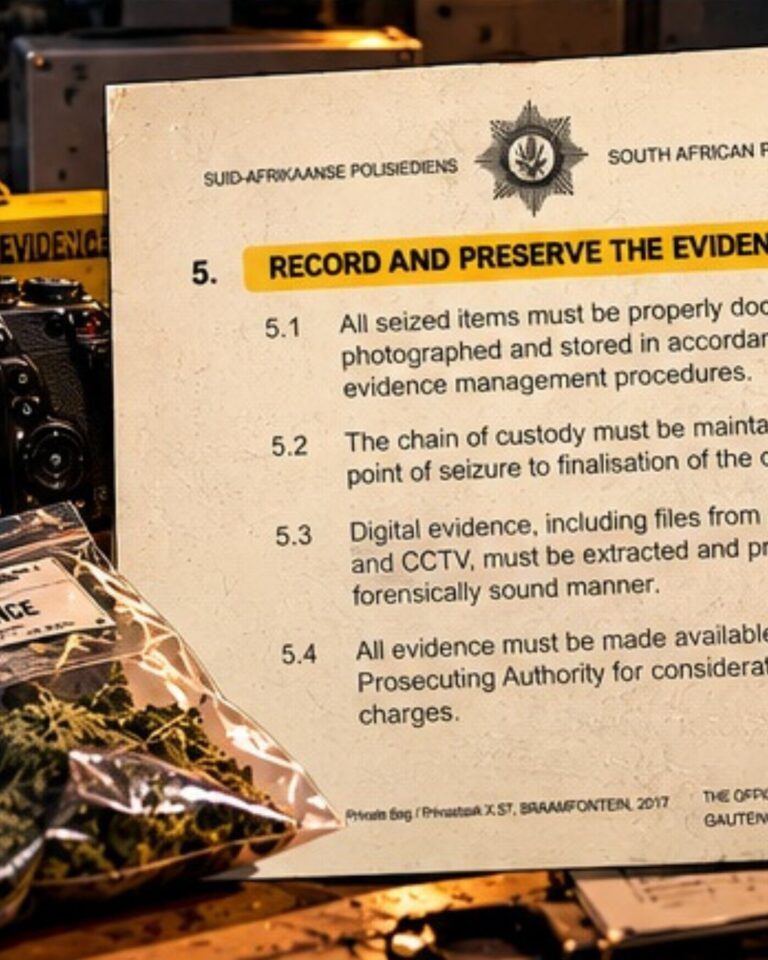
5. Record and Preserve the Evidence
The document reminds officers that seized evidence must be properly collected, recorded, packaged and accounted for.
The document refers to a previous case where problems with the chain of evidence became an issue.
This is an important part of any criminal investigation.
If products are seized, officers must follow the applicable procedures for handling and preserving evidence.
Improper handling could become relevant if the evidence is challenged in court.
For businesses, it’s another reason to keep accurate stock records and document anything removed during a search.

Can Cannabis Businesses Challenge Police Searches and Seizures?
Yes. Police powers have legal limits, and cannabis businesses can challenge searches or seizures they believe were unlawful.
For example, questions about how seized cannabis was weighed, recorded or handled could become relevant when challenging the accuracy of the evidence or the procedures followed.
However, that doesn’t mean every cannabis retailer has an automatic defence against enforcement action. Whether a challenge succeeds depends on the circumstances and whether police acted within their legal powers.

What Should Business Owners Check During a Police Operation?
Start with the search warrant, if officers are relying on one.
Under the Criminal Procedure Act, a warrant generally needs to identify the suspected offence, where police are authorised to search and the items they may seize.
Business owners should also:
- Ask officers to identify themselves and explain the legal authority for the search.
- Check whether the warrant covers the premises being searched.
- Ask for the relevant case number or investigation reference.
- Keep copies of any paperwork provided.
- Request a record of the stock, equipment or other items removed.
- Note the time, date and details of the operation.
- Contact a lawyer if the search appears to exceed the authority granted.
Section 21(4) of the Criminal Procedure Act also provides for an affected person to obtain a copy of the warrant on demand after its execution.
Remember, police can conduct certain warrantless searches where the law permits them.
If officers cannot produce a warrant, ask what legal authority they’re relying on. Don’t physically obstruct the operation.
Yes. Police powers have legal limits, and cannabis businesses can challenge searches or seizures they believe were unlawful.
For example, questions about how seized cannabis was weighed, recorded or handled could become relevant when challenging the accuracy of the evidence or the procedures followed.
However, that doesn’t mean every cannabis retailer has an automatic defence against enforcement action. Whether a challenge succeeds depends on the circumstances and whether police acted within their legal powers.

What If the Search Warrant Is Incorrect?
South African courts have established that search warrants must meet legal requirements.
For example, the Constitutional Court’s Van der Merwe judgment dealt with warrants that failed to identify the offences being investigated.
Other potential problems include warrants that are too vague, authorise searches beyond what the law permits or fail to identify the premises and items sufficiently clearly.
A court can declare an invalid warrant unlawful.
But a minor mistake doesn’t automatically invalidate every warrant, and even a defective warrant doesn’t necessarily mean a criminal investigation must end.
The correct approach is to record the problem and obtain legal advice.

What If You're Arrested?
Section 35 of South Africa’s Constitution protects the rights of arrested people.
These include the right to remain silent, to be informed of the reason for an arrest and to consult a legal practitioner.
An arrested person must generally be brought before a court within 48 hours, subject to the constitutional rules dealing with weekends and public holidays.
If you’re arrested during a cannabis-related operation, ask to speak to a lawyer before making statements about the allegations.
You can seek assistance from Legal Aid South Africa if you qualify, or contact Fields of Green for ALL for information about cannabis rights and advocacy in South Africa.

What Happens If Police Seize Stock That Shouldn't Have Been Taken?
Here’s where things could become particularly complicated for cannabis retailers.
What happens if police seize products unlawfully, damage them, lose them or fail to return goods that should legally be returned?
The answer isn’t necessarily that the business must simply accept the loss.
South African law provides mechanisms for the return of seized property, and in certain circumstances, financial compensation may also be possible.
But the legal status of the stock matters.

Can Businesses Demand the Return of Seized Stock?
Under Section 31 of the Criminal Procedure Act, seized property generally has to be returned when no criminal proceedings are instituted or it is no longer required for those proceedings, provided the person is legally entitled to possess it.
If the person from whom it was seized cannot lawfully possess the item, the legislation provides for its return to someone who can lawfully possess it, where such a person exists.
Property that cannot legally be possessed may be subject to forfeiture.
That distinction is particularly important in the cannabis industry.
A retailer may argue that certain products were legally held, but that would need to be supported by the relevant legislation, licences or permits.
Simply having stock in a shop doesn’t automatically establish a right to its return.
Likewise, the fact that police seized something doesn’t automatically establish that the seizure was justified.

Can Businesses Sue SAPS for Lost or Damaged Stock?
Potentially, yes.
South African courts have dealt with claims involving property that was confiscated during criminal investigations and subsequently lost or destroyed.
One particularly relevant example is the Minister of Police v Ndobe case.
The matter arose after Zimele Maxwell Ndobe was arrested in 2012 on a cannabis possession charge.
Police confiscated his bakkie and placed it in an SAPS impound facility.
The criminal charges were later withdrawn.
However, despite his attempts to recover the vehicle, Ndobe was eventually informed that it had been destroyed in a fire while in police custody.
He pursued a damages claim against the Minister of Police, including a claim relating to income he said he had lost because he could no longer use the vehicle for his business.
The litigation reached the Gauteng High Court on appeal in 2026.
Although the case concerned a vehicle rather than cannabis stock, it illustrates that financial losses arising from property held by police can become the subject of civil proceedings.
But it doesn’t establish that every cannabis retailer whose goods are seized can automatically claim compensation.
A claim would depend on factors including the lawfulness of the seizure, any failure by police to safeguard the property, whether the business could legally possess the products, and the financial loss that can be proven.

The Paperwork Could Make All the Difference
That includes purchase invoices, supplier information, applicable licences and permits, stock inventories and financial records.
If products are seized, record exactly what was taken and request the relevant seizure documentation.
Where possible, retain photographs, product descriptions, quantities and evidence of the goods’ condition and value.
It’s also worth establishing which authority has custody of the products and how they will be stored.
If the seizure is later challenged, these records may help establish what happened, what was lost and whether the business has grounds to pursue the return of goods or compensation.
We’re not legal experts, but if cannabis retailers are preparing for possible police operations, they should also be preparing for the paperwork that could follow.
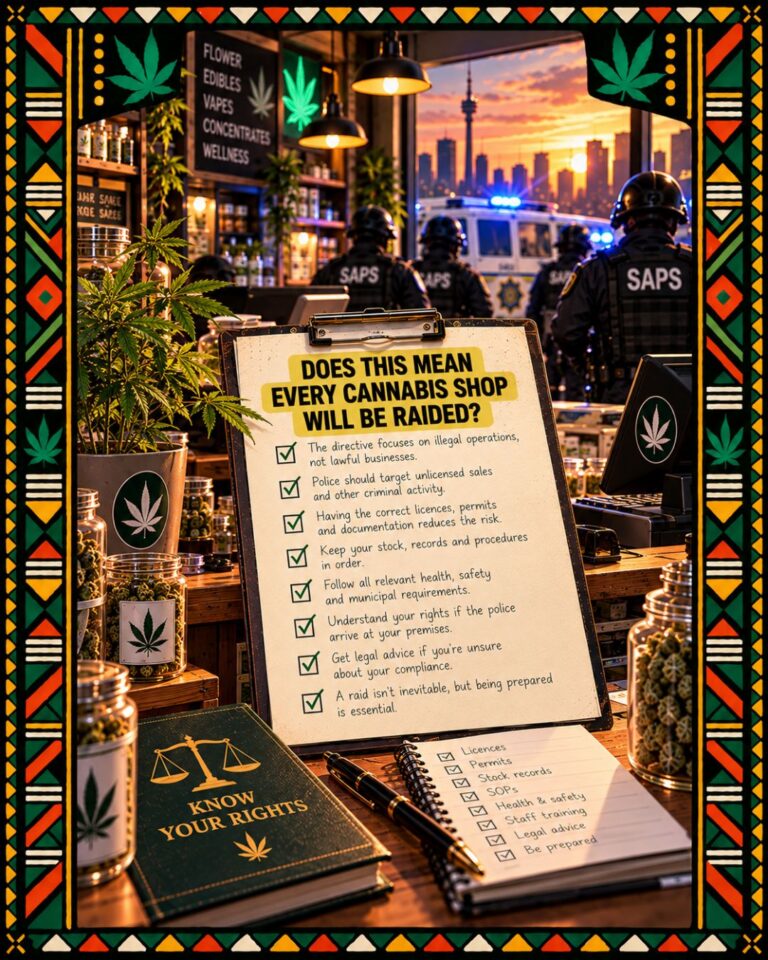
Does This Mean Every Cannabis Shop Will Be Raided?
Not necessarily.
The reported document doesn’t identify specific businesses, announce dates for operations or establish that raids have already taken place.
Its concluding section calls for commanders to bring the instructions to officers’ attention for immediate implementation.
That is what the document says, not independent evidence that implementation has begun.
If authentic, that would make it more than a general discussion about cannabis law.
It describes proposed procedures for investigations, including warrants, searches, possible undercover operations, arrests and criminal charges.
But the document itself doesn’t determine whether every retailer is operating illegally.
Nor does it give police powers beyond those permitted by legislation and the Constitution.
Those questions remain subject to the facts of each case and, where challenged, the courts.

The Revolution Isn't Over
The reported Gauteng police directive has surfaced at an interesting moment in South Africa’s cannabis history.
Eight years after the Constitutional Court’s landmark private-use judgment, uncertainty remains around commercial cannabis sales, policing and regulation.
While the Constitution protects adult private use, the legal position of cannabis businesses remains far less straightforward.
Police have a responsibility to investigate suspected criminal activity, but businesses and consumers also deserve clear rules and lawful procedures.
The document raises important questions about how cannabis products are seized, handled and returned, particularly when their legal status is disputed.
These are questions that still need answers.
And as South Africa approaches the second annual Revolution Day, one thing is clear.
We’re not simply remembering the revolution. We’re still living through it.